
Round RockRound Rock
Schools, work and groceries, all close by. It’s where families moving to Austin look first — and where they stay.
Close to school, workand the grocery store.
What homes sell forin Round Rock right now.
The Jan–Aug 2026 median compared with last year. Single-month numbers swing with the number of sales.
Source: Unlock MLS Residential Market Snapshot (Round Rock, residential), retrieved Sep 26, 2026. Deemed reliable but not guaranteed.
Mostly Round Rock ISD. Check any address in seconds.
Elementary and middle schools listed are those with Round Rock addresses (78664, 78665, 78681; Round Rock ISD 2025–26). Westwood (IB) and McNeil are Round Rock ISD high schools with Austin addresses. Zoning varies within the city — always verify by address before you choose a home.
Check zoned schools ↗How faris the office?
Typical drive times from central Round Rock. Allow more at rush hour.
Close on weekdays.Fun on weekends.
Where you’lldo your shopping.
For Costco, use Georgetown, Pflugerville or Cedar Park.
A finished city,growing once more.
A major parks program, a new mixed-use district and a hospital expansion are all under way.
Sources: Community Impact (2025–2026), City of Round Rock, Samsung announcements. Timelines are as announced and may change.
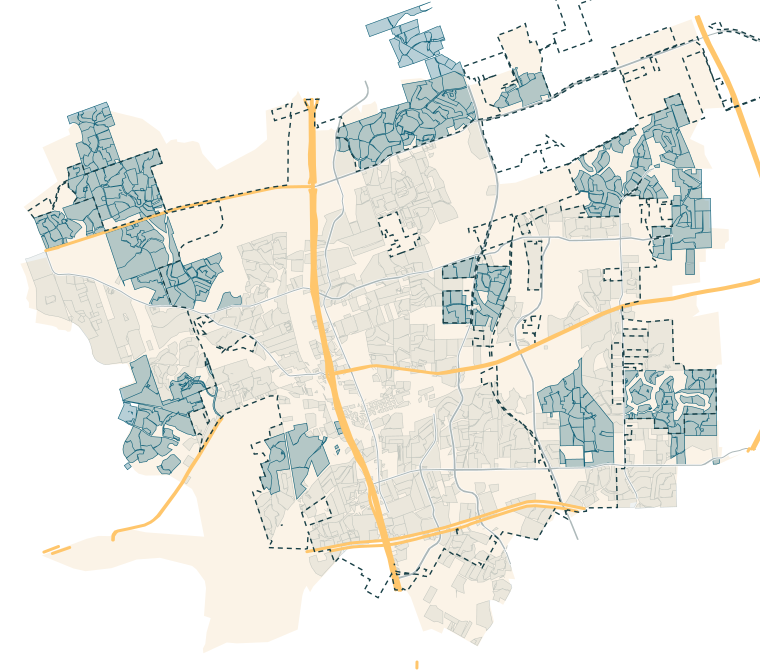
Same city.Very different neighborhoods.
Numbers on the map match the cards below. Prices vary a lot within each neighborhood, so we leave them out — ask us and we’ll walk you through recent sales.
A roughly 1,500-acre master-planned community begun in 2001, built around an 18-hole golf course and spanning Round Rock and Georgetown.
A large neighborhood built from the 1990s through the 2010s around a public golf course, with mature trees.
A master-planned community on the east side, built from the late 2000s. It has a Round Rock address but is served by Hutto ISD.
An east-side master-planned community (late 2000s–2010s) around a 47-acre private lake. A MUD makes the tax rate a bit higher.
A master-planned community built from the mid-2010s, split into a 55+ section (Heritage) and an all-ages section (Traditions).
About 1,000 homes on the west side, built 2000–2014, with lots on the larger side.
A small, upscale west-side neighborhood of 238 homes, many over 3,000 sq ft.
A northwest neighborhood from the late 2000s–2010s (including Highlands and Village), connected directly to Southwest Williamson County Regional Park.
632 homes with a 42-acre greenbelt through the middle, plus access to Brushy Creek MUD facilities.
The heart of the Brushy Creek MUD, developed from the late 1970s. The MUD runs the parks, pools and community center.
A Brushy Creek MUD neighborhood built from the late 1980s to early 2000s, with easy access to RM 620, I-35 and SH 45.
A MUD neighborhood built from the late 1980s to early 2000s, with six parks and trails but no pool.
An established neighborhood with mostly 1970s–80s homes. No HOA, but an active neighborhood association.
A northwest neighborhood centered on the Preserve at Stone Oak, with more than 30 acres of greenbelt.
An east-side neighborhood near Palm Valley, built from the late 1990s to the 2010s, with a large park, pool and sports fields.
Built from the late 1980s to early 2000s. It has a Round Rock address but is served by Leander ISD.
A southeast neighborhood built in the early 2000s, with two pools, ponds and walking trails.
Built from the 2000s to early 2010s near Gattis School Road, with a fishing pond, park and year-round pool.
Zoned schools come from checking several points in each neighborhood against each district’s public attendance-zone map (Round Rock ISD 2025–26 and others). Zones change and can split a neighborhood — always confirm by address. Amenities are from HOA, MUD and city public information.
"Round Rock isn’t the safe choice — it’s the hard-to-get-wrong choice. Schools, work and groceries are mostly within 20 minutes."
It’s the neighborhood I suggest most often to families arriving for the first time. Renting first, then buying within the same school district, comes naturally here.